Software is not done at design phase
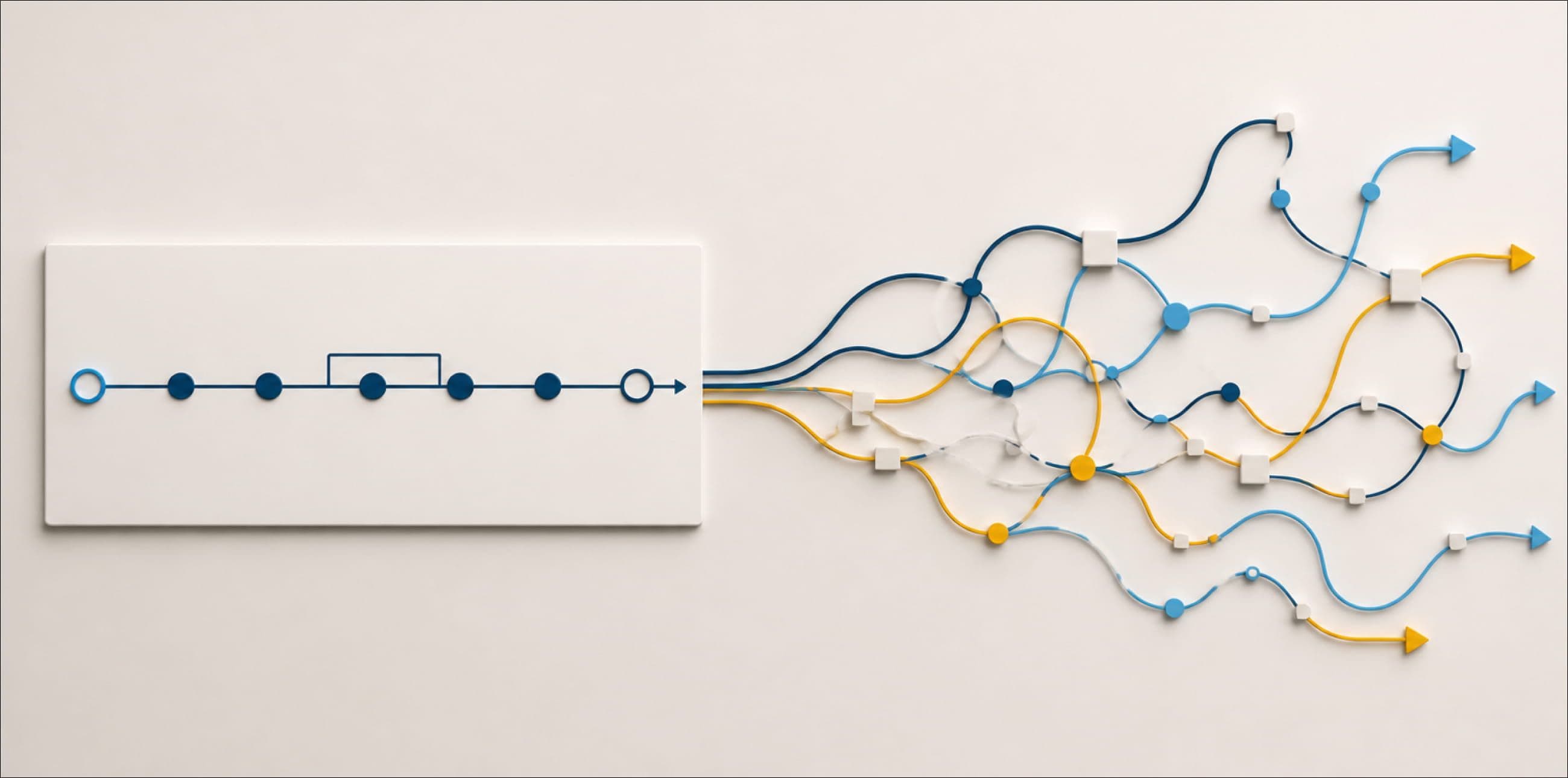
Defining a business process does not mean the software is complete. It simply creates the first model of how the business is expected to operate. Only when people begin using the system in their daily work does it become clear how much real execution differs from the documented process.
Documentation almost always describes the ideal workflow. In practice, employees combine steps, skip activities, postpone data entry, or resolve urgent situations outside the application because the business cannot wait. The software has not failed. It is simply encountering operational conditions that were never fully visible during the design phase.
This is why operational teams should be involved throughout the entire software development process, not only during initial requirements gathering. Their daily experience reveals business situations that documentation alone can rarely capture with enough precision.
Execution does not follow documentation
Documentation is a simplified version of reality. It describes how work happens under ideal conditions. Execution happens under pressure, tasks are not completed in sequence. Some steps are left behind, next action emerges. Data is recorded later, when the job is done. Decisions are made outside the system, waiting for a formal flow would slow down execution.
The documented workflow remains unchanged, but daily operations gradually evolve around it. This does not happen because employees ignore the process. It happens because they optimize their work to meet operational demands. Over time, those adaptations become the real business process, while the documented workflow remains only the official version of how the organization believes work is performed.
Operational work creates multiple parallel flows
The organization operates under different conditions. Warehouse execution reacts to volume. Field work reacts to environment. Support reacts to incoming pressure. Sales reacts to ongoing communication.
These flows do not align. Each of them has its own pace. The system assumes one structured path, while reality shows separate progressions. Several paths run at the same time, depending on context and urgency.
Only part of this activity is captured inside the system.
Formal process and real coordination diverge
Work is expected to follow a defined path. A request is created, approved, and executed through the system.
In reality this does not happen; a call replaces a request, a message replaces approval. Execution happens without a delay in daily work. Entry in the system is added later, if added at all.
The formal process remains in documentation. The real coordination happens through direct communication.
Load exposes differences in warehouse execution
Warehouse operations follow a predictable pattern. Picking and packing align with system flow. But when volume increases, execution paths change.
To reduce blocking, workers reorder. Items are taken from alternative locations, some orders are even paused, and processed later. The structured sequence is present, but execution is no longer aligned with it.
The difference occurs only when pressure increases.
Field execution depends on conditions on the field
Field operations are affected by environment and communication availability. Equipment does not always work. When conditions on the field change, execution follows. Work continues unupdated in the system. That will be taken care of later. Data is recorded after the task is completed.
As a result, the system record matches reality, but not in the same timeline.
Communication interruptions change system behaviour
Field teams do not always operate with connectivity. When communication breaks, decisions are made locally. Job needs to be done. Execution continues, even without the system. Information is added in partial form, once connection is restored.
The system does not represent live execution, only a delayed reconstruction of events.
During the development of EUDoctor, system complexity did not become visible while the platform was being built. It emerged only after doctors and patients started using it in everyday consultations. Workflows that initially appeared straightforward gradually changed depending on consultation type, urgency, country-specific regulations, and the operational routines of individual clinics.
Steps that had originally been modelled as separate activities were often combined, skipped, or performed in a different order. Not because users were using the system incorrectly, but because real healthcare operations required a different sequence of work than the one originally documented.
Most improvements introduced after launch were not driven by technical defects. They resulted from observing how healthcare professionals actually worked in production. Real operational behaviour revealed situations that simply could not have been fully identified during the design phase, making post-launch adaptation a natural part of the software development process.
First signals appear in support
System issues are first visible through user feedback. A single task takes longer than expected. A process that worked before no longer behaves the same. A user cannot repeat a flow that they had done a moment ago…
Each case looks isolated. Then patterns begin to repeat across different users. The issue is no longer individual mistake. It becomes a gap between documented process and real execution.
Those patterns are grouped into development work. It is a fresh start for a new polish of a software solution.
Sales execution diverges from CRM structure
Sales processes are defined as linear stages. The problem is that they do not occur that way. A lead enters the system and moves through defined steps. In real execution, this structure does not always happen.
Conversations move back and forth. Information is added after initial contact. Decisions are made before the data has been captured. Part of the communication happens outside CRM, but the execution does not wait for full system input.
CRM records what can be reconstructed, but it's not a real time scenario. System data and real activity diverge.
Business software does not become stable when the specification is completed or when the first version is released. It becomes stable only after the system has adapted to the way people actually perform their work. Operational teams gradually expose situations that could never be fully predicted during planning, and those situations become the foundation for future improvements.
The closer the software reflects real execution instead of documented assumptions, the less employees need to rely on workarounds, manual coordination, and external communication. That is the point where the system becomes part of everyday operations instead of something that operations constantly need to work around.